Misa de Gallo, or Mass of the Rooster officially kicked off the Christmas season in the country last Friday, 16 December. For nine days, called the novena, Catholics wake up early than usual and brave the nippy cold to hear mass. Originally a practice in Mexico, it was extended to the Philippines in the 16th century not out of tradition but for practical reasons: the dawn masses were timed very early so that the farmers during those time can fit it in their schedules as during the day, they’ll be busy with farm work. While this are dawn masses, the Tagalogs call it Simbang Gabi, literally night mass.
When we were still children, we used to accompany my lola (grandmother) and mother to these masses, oftentimes, because of the cold water, would just wash our faces instead of shower. After, we would then buy puto (unground steamed sticky rice with ginger) to be dipped in sugar (my fave) or paired with sweet ripe mangoes and thick tsokolate, made from tablea, medallion shaped bitter chocolate made from pure cocoa.
Especially loooove bibingka -- it's a rice cake with salted duck egg and goat's cheese, topped with butter, a sprinkle of sugar and grated coconut. Yum! I'm glad it's available all year round now.
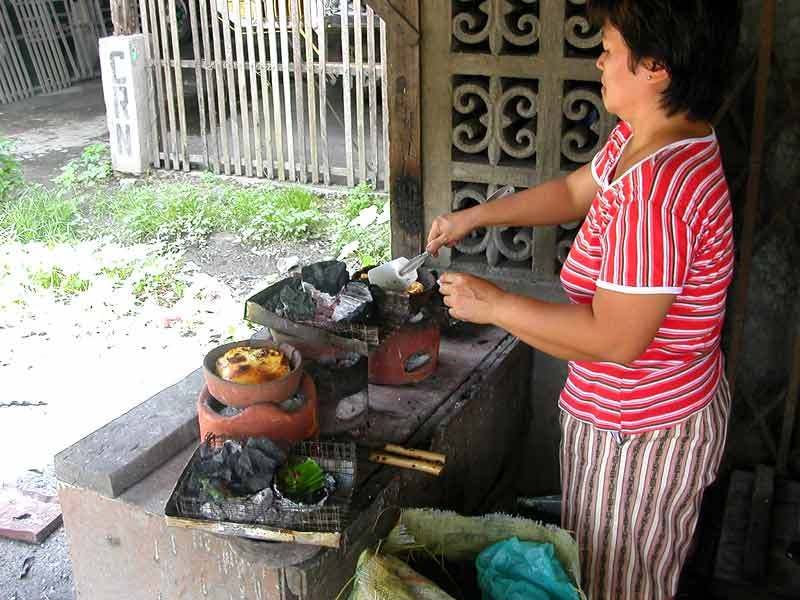
This strange looking contraption is a steamer for the puto bumbong. The sticky rice flour mixture is placed inside the bamboo atop a steamer. The cloth around the wood is used so that it can be handled like placing the mixture or retrieving the puto.
Misa del Gallo - Midnight Mass Starts Dec.15
Saturday, December 15, 2007 | Label christmas, pinoy tradition

Cultural Origins of the Christmas Parol
Friday, December 14, 2007 | Label christmas, pinoy culture, pinoy tradition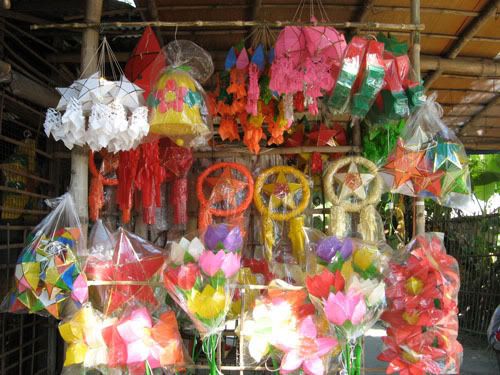
The villagers would walk around to appreciate the work of others and see who had the nicest design. When new stylistic variations appeared, such as different kind of tassels, steamers, or crowns around it, others would innovate their own creations and make palns to display their better parol the following year. This friendly competition was encoureaged by the church and the Spanish priests offered incentives for the people to invest time and money to make their parol the best as devotional offering to Jesus Christ. That is why during the Christmas season, some made it a practice to visit various churches that yearly display these new designs and better craftsmanship.
Today the parol is a main component in the Filipino celebration of Christmas which has become a Festival of Lights. The festivities cover the months ending with BER. Christmas music can be heard sporadically in the beginning of September and one could feel an increasing sense of the coming Christmas as more and more Christmas songs are played on the radio, and as more homes, businesses, streets and parks become brightly lit with wonderful colors. The mall and department stores are the first ones to decorate and showcase their managers and beautiful parol.
"Balut".. Filipino delicacy and pinoys lovin' it
Friday, November 30, 2007 | Label pinoy food, pinoy tradition
Preparation
Balut are most often eaten with a pinch of salt, though some balut-eaters prefer chili and vinegar to complement their egg. The eggs are savored for their balance of textures and flavors; the broth surrounding the embryo is sipped from the egg before the shell is peeled and the yolk and young chick inside can be eaten. All of the contents of the egg are consumed. In the Philippines, balut have recently entered higher cuisine by being served as appetizers in restaurants: cooked adobo style, fried in omelettes or even used as filling in baked pastries.
Balut-making is not native to the Philippines. A similar preparation is known in China as maodan (Chinese: 毛蛋; pinyin: máodàn; literally "furry egg"), and Chinese traders and migrants are said to have brought the idea of eating fertilized duck eggs to the Philippines. However, the knowledge and craft of balut-making has been localized by the balut-makers (mangbabalut). Today, balut production has not been mechanized in favor of the traditional production by hand. Although balut are produced throughout the Philippines, balut-makers in Pateros are renowned for their careful selection and incubation of the eggs.
Fertilized duck eggs are kept warm in the sun and stored in baskets to retain warmth. After nine days, the eggs are held to a light to reveal the embryo inside. Approximately eight days later the balut are ready to be cooked, sold, and eaten. Vendors sell cooked balut out of buckets of sand, used to retain warmth, and are accompanied by small packets of salt. Uncooked balut are rarely sold in Southeast Asia. In the United States, many Asian markets occasionally carry uncooked balut eggs, though their demand in North America is not very great. The cooking process is identical to that of hard-boiled chicken eggs, and baluts are enjoyed while still warm.
Duck eggs that are not properly developed after nine to twelve days are sold as penoy, which look, smell and taste similar to a regular hard-boiled egg. In Filipino cuisine, these are occasionally beaten and fried, similar to scrambled eggs, and served with a vinegar dip.
The age of the egg before it can be cooked is a matter of local preference. In the Philippines, the perfect balut is 17 days old, at which point it is said to be balut sa puti ("wrapped in white"). The chick inside is not old enough to show its beak, feathers or claws and the bones are undeveloped. The Vietnamese prefer their balut matured from 19 days up to 21 days, when the chick is old enough to be recognizable as a baby duck and has bones that will be firm but tender when cooked. In Cambodia, most people prefer to eat it while it is still warm in its shell. Served with nothing more than a little garnish, it is widely popular. Usually, it is accompanied by a mixture of lime juice and ground pepper.
In popular media
Balut has been the "shocking" topic of some television shows because of its taboo nature in some Western cultures. In two episodes of Survivor: Palau and one episode of Survivor: China, the contestants were made to eat this Asian delicacy. Similarly, balut is frequently featured on Fear Factor. Recently, contestants of The Amazing Race Asia 2 had to eat 8 baluts as a team before receiving their next clue. Balut was also featured on the show Bizarre Foods with Andrew Zimmern, where the host pronounced 18-day-old balut to be one the strangest foods he'd ever eaten in his life, but far better tasting than he had expected. The members of the rock band Switchfoot ate balut on stage at their concert in the Philippines. Video footage of this occurrence can be seen on the Switchfoot Podcast, episode 28.
Video of eating balut:
Big Christmas Trees All over the Malls
Wednesday, November 14, 2007 | Label christmas, pinoy traditionBig shining christmas trees are everywhere in all the malls of philippines. Its a tradition there to have those giant trees when christmas is coming. Oh how i miss going to all the malls there at Manila.
Parols (Christmas Ornaments)are also everynow. Even here in Daly City, lots of Filipinos hanging there lighting parol. Parols are traditionally made out of bamboo and paper although plastics are sometimes preferred and elaborate ones are made from capiz shells. They are traditionally star-shaped, and is thought of to symbolize the star of Bethlehem. They are usually hung outdoors on doors, patios, windows and other. They are the equivalent of Christmas wreaths in the western world.